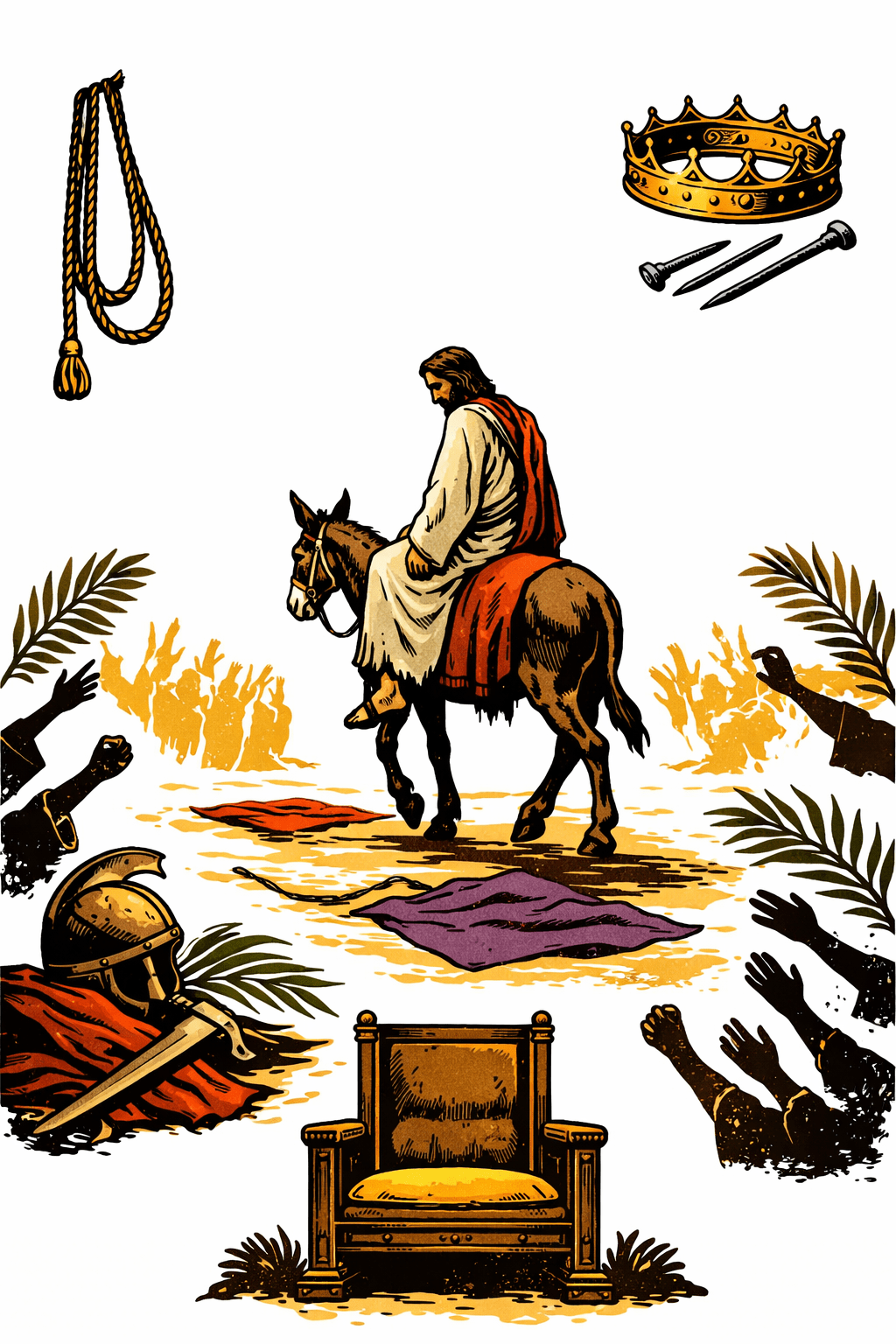
Palm Sunday is often remembered in bright colours, with palms raised high and voices filled with praise. It seems like a moment of arrival, of recognition, almost of fulfilment. Yet if one looks closely, there is a silent contradiction running beneath it. The scene holds together outward joy and inward emptiness at the same time. It offers honour, but without permanence. It gives the appearance of greatness, but strips away everything that usually supports it.
There is an unspoken disturbance at the heart of that scene. It appears like honour, yet it carries no weight. A king enters, and yet nothing around him can be called his own. The animal is borrowed. The road is softened by garments that will be taken back. The voices rise, but they do not rest on truth. Everything is given, yet everything is passing.
He does not resist this. He does not secure it. He does not try to make the moment hold. He receives it as it is, and continues. That is where the unease begins. One expects some gesture of claim, some sign of possession, some effort to preserve what is being offered. There is none.
It brings to mind a simple but severe fact about human life. Much of what we cherish rests on conditions that do not endure. Praise depends on mood. Loyalty bends under pressure. Even love, when it is not grounded deeply, shifts with circumstance. We often live as though these things are stable, but they are not.
And yet he walks into that instability without hesitation. There is no bitterness in him, no withdrawal, no attempt to expose the crowd. He accepts what is partial without demanding that it become complete. There is a kind of patience here that is difficult to comprehend. Not the patience that waits to be rewarded, but the patience that gives without requiring return.
This is where the scene touches something more exacting. It suggests that dignity does not arise from what one possesses, but from the manner in which one stands within what is given. The absence of ownership does not diminish him. If anything, it reveals a freedom that possession cannot provide.
Still, it is not easy to sit with this. It unsettles ordinary instincts. We are inclined to secure, to hold, to protect what we receive. We measure value by what remains. Here, nothing is held, and yet nothing is lost in him. That contrast is difficult to accept.
Perhaps that is why the moment carries a sadness. It shows how easily we give what we cannot sustain, and how gently it is received. It also shows a different way of living, one that does not depend on certainty, yet does not collapse in its absence.
He enters the city with nothing that will last. Yet he does not appear diminished. That is the part that lingers. It leaves behind a question that does not resolve quickly. If so little was His, and yet He stood so complete, then what, in the end, do we really need in order to be whole?


 Zabenthung Dominic
Leave a reply to gailungliu2020 Cancel reply