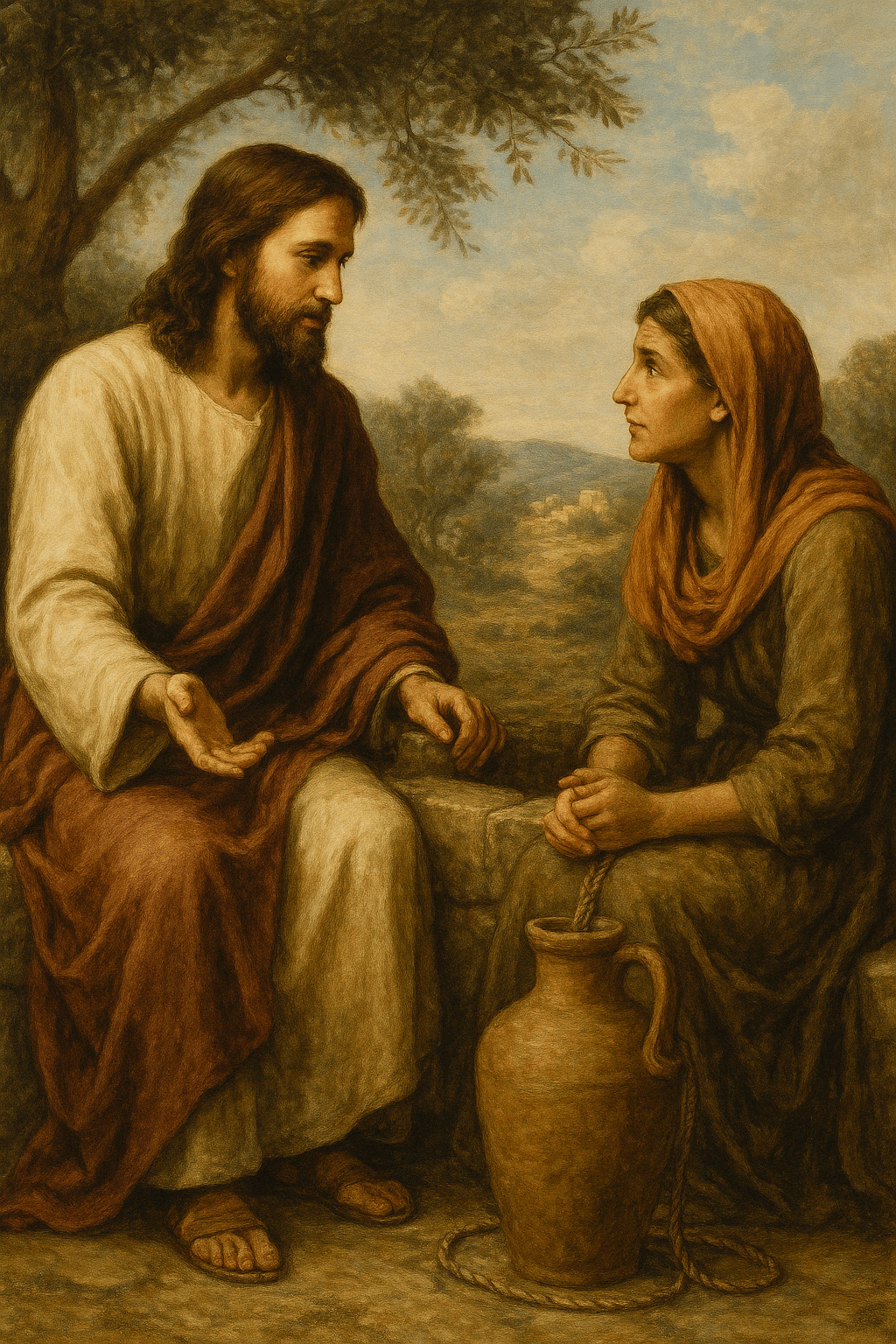
At the hottest hour of the day,
when the sun stands still
and even the birds grow quiet,
a woman walks alone to Jacob’s well.
The world has named her many things—
outsider, sinner, unworthy—
so she walks when no one else does.
She carries a jar,
but also silence,
shame,
and the quiet ache of being forgotten.
But today, someone is waiting.
A man. A Jew.
Sitting at the well, dusty from travel,
with no jar of His own.
He looks at her—not with suspicion,
not with superiority,
but with something softer.
With longing.
Not just for water,
but for connection.
“Give Me a drink,” He says.
The words surprise her.
“How is it that You, a Jew,
ask me, a Samaritan woman, for a drink?”
Her tone is cautious.
She knows the rules.
Jews don’t share cups with Samaritans.
Men don’t speak to women like her.
And yet—He speaks.
“If you knew who was asking,
you would ask Me,
and I would give you living water.”
She laughs a little,
half-curious, half-wounded.
“You have no bucket.
And the well is deep.
Where can You get this living water?”
But He goes deeper than wells and jars.
“Everyone who drinks this water
will be thirsty again.
But whoever drinks the water I give
will never thirst.
It will become a spring inside—
welling up to eternal life.”
She still doesn’t fully understand,
but something inside her leans in.
“Sir, give me this water,
so I won’t be thirsty
or have to keep coming here alone.”
And then—He touches the wound.
“Go, call your husband.”
“I have no husband,” she replies quickly.
“You’re right,” He says gently.
“You’ve had five husbands,
and the man you now live with isn’t your husband.”
She freezes.
He knows.
He knows everything.
Yet His voice holds no sharpness,
no scorn.
Only truth.
Only love.
“Sir, I see You are a prophet,” she says,
and then, to hide her heart,
she turns to religion:
“Our ancestors worshiped on this mountain,
but you Jews say Jerusalem is the place.”
He answers,
but not with a debate.
“The time is coming—
is now here—
when worship won’t be about mountains or temples.
The true worshippers will worship in spirit and truth.
That’s the kind of worshipper the Father seeks.”
She whispers,
“I know the Messiah is coming.
When He comes, He will explain everything.”
And then He speaks the words
that shift the ground beneath her feet:
“I—the one speaking to you—am He.”
She stares.
The world stands still.
No thunder. No lightning.
Just a quiet revelation
at the edge of a forgotten town.
Just then, His disciples return.
They say nothing,
but their eyes speak volumes.
Still, she doesn’t wait.
She leaves her jar—
the very reason she came.
And runs.
Runs back to the village
she once avoided.
“Come, see a man
who told me everything I’ve ever done.
Could this be the Messiah?”
And they come.
Not because of miracles.
But because of her.
Because of one woman,
once buried by shame,
now alive with wonder.
Because at the well,
she was not judged.
She was not fixed.
She was not dismissed.
She was seen.
Known.
Loved.
She drank from a deeper well—
and became one herself.
And perhaps the living water
was not a thing to hold,
but a truth to awaken:
That the One who made the stars
waits by wells in the heat of the day
for hearts like hers—
and ours.

 Zabenthung Dominic
Leave a comment